Discovering Volunteer Farming Programs in Canada: A Unique Adventure Awaits

Updated: Mar 11
Volunteer Farming Programs in Canada: What They’re Really Like
Volunteer farming programs in Canada attract people from all over the world who are looking for hands-on experience, a connection to the land, and something more meaningful than typical travel.
But what do these programs actually look like day to day? What happens when strangers arrive on a working farm and begin sharing life together?
This post offers an honest look at volunteer farming programs in Canada based on years of hosting volunteers and international students at Campbell Land, a family-run grain farm in Northern Alberta.
What Volunteer Farming Programs in Canada Really Are
At their core, volunteer farming programs are about participation, not observation.
Volunteers live and work on a functioning farm, contributing to daily life while learning through real responsibility. The learning doesn't come from lectures or rigid schedules written months in advance. It comes from showing up, paying attention, and becoming part of the rhythm of the place.
At Campbell Land, volunteers aren't treated as temporary outsiders. They become part of the flow of farm life — work, meals, conversations, and shared responsibility.
One of the things that surprises people most is how quickly they begin to feel at home.
A Story of Integration: How Belonging Actually Happens
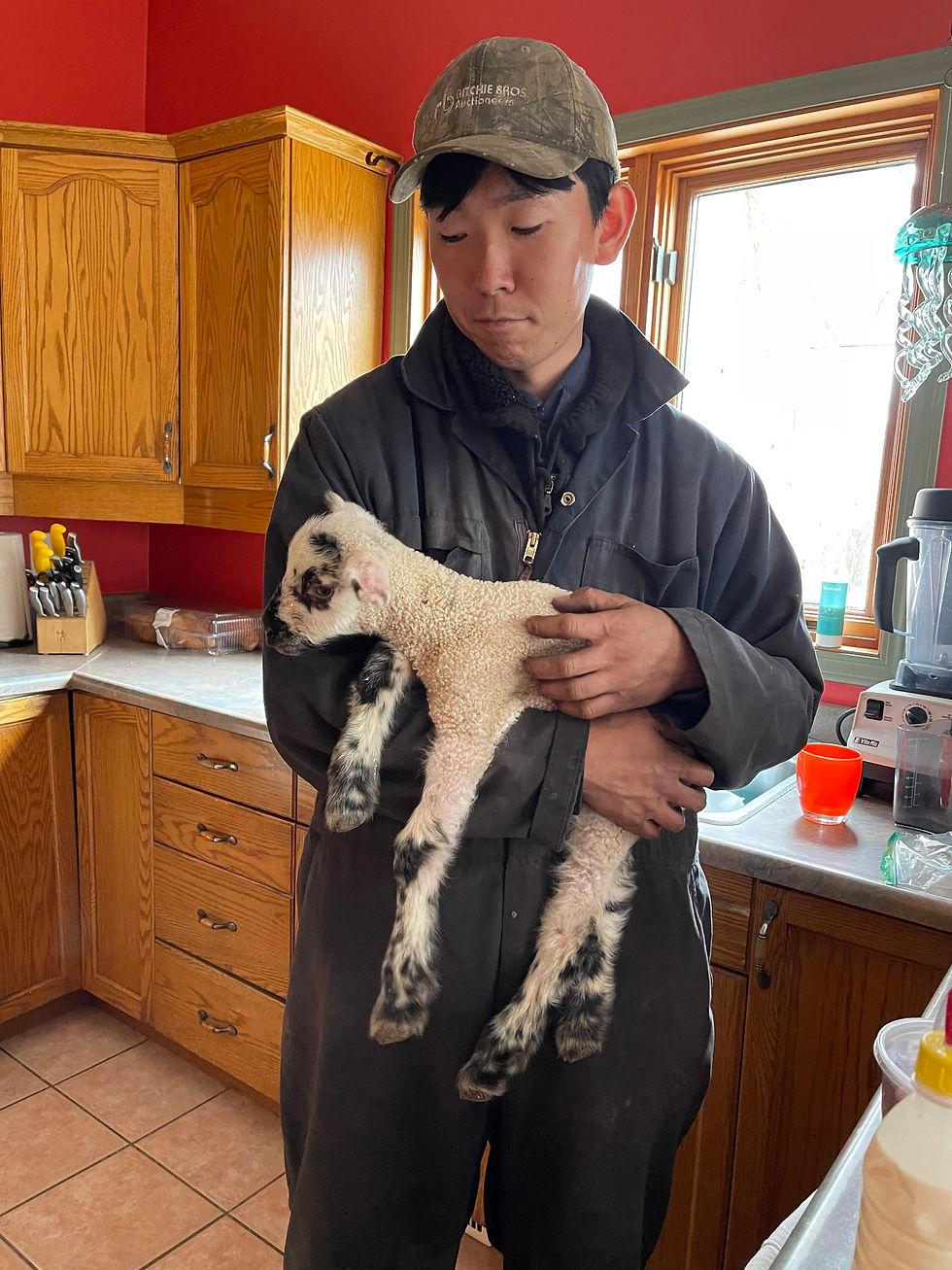
One winter, during a deep cold snap, a young man named Daichi arrived from Japan.
Leading up to his arrival, communication had been slow and sporadic. Later we learned he had been walking the Camino de Santiago, moving in and out of Wi-Fi.
When he finally arrived it was dark, bitterly cold, and snow-covered. Strangers meeting strangers in the middle of a northern winter.
His English was limited. The weather was harsh. The situation could easily have felt intimidating.
So instead of pushing conversation, we baked together.
There is something timeless about breaking bread with someone. Flour, laughter, warmth, and shared effort dissolve barriers faster than words ever could.
In the evenings Daichi sat at the table trying to read Harry Potter. It was difficult.
So we stepped back and found children's books with pictures. Slowly we built confidence — basic sentences, then short stories, then chapter books.
Before long he was reading Harry Potter again.
He shoveled snow. We went on winter hikes. One night he cooked Japanese supper for us. Another time he made breakfast.
We shared stories about culture, respect, and everyday life. He explained how in Japan students and staff clean their own schools — no janitors — as a way of practicing responsibility and respect.
When it was time for him to leave, his gap year was ending and university was calling him back.
Before leaving he asked quietly,
"When I graduate… can I come back? I don’t think I’m finished here yet."
Months later a message arrived:
"Hi, it’s Daichi. I’m graduating in April. I was wondering if I could come back."
That’s how many volunteer farming experiences truly work — not as transactions, but as relationships that continue.
What the First Week Usually Looks Like
The first week is about grounding.
We practice English if needed.We ease into the chore schedule.We get to know one another.
I learn what a volunteer is curious about, what their goals are, and what they hope to explore.
From there we often co-create projects. No two experiences look exactly the same because no two people are the same.
Some people need time to settle. Others jump in immediately.
Both approaches are fine — as long as there is openness.
What Changes by the End of a Stay
By the time volunteers leave, something subtle but noticeable has shifted.
Yes, their English is usually stronger.
But more importantly, people often leave more grounded and confident. They stand differently. They speak more clearly. They feel capable.
Many volunteers say the same thing when they leave:
"I want to come back."
And many do.
Thanks to Instagram, Facebook, and WhatsApp, we stay connected and watch people step into their lives around the world.
Who Thrives in Volunteer Farming Programs — and Who Doesn’t
The people who thrive at Campbell Land aren't defined by experience or physical strength.
They thrive because they want the experience and embrace it fully.
They stay curious.They participate.They step into something unfamiliar.
Hosting people is a bit like cooking a recipe without knowing exactly how it will turn out.
Sometimes 1 + 1 becomes 3.
Something larger is created through connection.
On the other hand, people who struggle often:
• Say they want the experience but resist it• Stay guarded and closed off• Focus on what went wrong instead of what’s working• Stay glued to their phones• Are physically present but not truly engaged
Volunteer farming only works when participation is genuine.
What Volunteer Farming Programs Are Not
One of the biggest misunderstandings is that volunteer farming programs are a kind of free travel experience.
They are not.
Volunteer farming programs are not:
• A free-for-all• A party hostel• A place to sleep in and relax all day• An entitlement-based experience
This is a working farm.
Safety, collaboration, and contribution matter.
Volunteers are invited along for the ride — but the ride requires respect.
Finding Volunteer Farming Programs in Canada
Many people discover volunteer farming opportunities through platforms such as:
• Workaway• Worldpackers• Other farm volunteer networks
These platforms can be a helpful place to begin exploring.
Campbell Land also accepts volunteers and interns directly. This allows for clearer expectations, better communication, and a more intentional match between the person and the farm.
Regardless of how someone finds us, the experience remains grounded in responsibility, learning, and participation.
Why I Still Host After All These Years
I still host people because it feels like my calling.
It fills my heart.
In a way, it allows me to travel the world without leaving home.
One night we might share a lasagna that took hours to prepare.
Another night it might be French-style fish with lemon butter sauce followed by chocolate mousse made from eggs collected that morning.
Food, work, stories, laughter — this is how connection happens.
And when it happens well, it's powerful.
Is a Volunteer Farming Program in Canada Right for You?
Volunteer farming programs in Canada tend to work best for people who:
• Want hands-on learning
• Are open and curious
• Value contribution and community
• Are willing to participate fully
Campbell Land isn't for everyone — and that's intentional.
But for the right people, it becomes something they carry with them long after they leave.
Volunteer Farming Programs in Canada: What You Should Know
If you're considering joining a volunteer farming program in Canada, here are a few practical things to keep in mind:
• Most programs involve real farm work, not demonstrations or tours
• Volunteers usually live on the farm and share meals with the host family
• The experience changes depending on the season and farm activities
• Curiosity, reliability, and participation matter more than previous experience
• Many volunteers join through platforms like Workaway or Worldpackers, while others apply directly to farms
Volunteer farming works best when people arrive ready to participate, learn, and contribute to the rhythm of farm life.

Comments